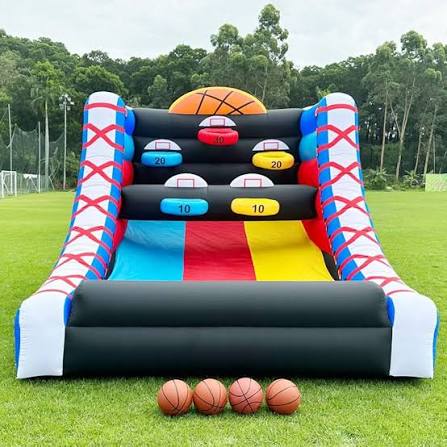
Inflatable games have become popular attractions at birthday parties, school events, community festivals, corporate gatherings, and commercial entertainment venues. From colorful bounce houses and inflatable slides to obstacle courses and interactive sports challenges, these products provide engaging entertainment for participants of different ages. However, their durability depends on more than attractive designs and creative features. The materials used during manufacturing play a crucial role in determining their strength, flexibility, resistance to wear, and overall service life.
Manufacturers select materials according to the inflatable’s intended use, size, construction, and expected operating conditions. Some products require lightweight fabrics for easy transportation, while others need reinforced materials to withstand frequent commercial use.
Understanding the materials used to manufacture Inflatable Games can help event organizers, rental businesses, and buyers make informed purchasing decisions. This article explores the most common materials, their advantages and limitations, and the factors that influence the durability of inflatable entertainment equipment.
Why Material Selection Matters for Inflatable Games
Inflatable products must maintain their intended shape and performance while experiencing repeated inflation, deflation, movement, and contact with users. Depending on the design, they may also face exposure to sunlight, moisture, dirt, and changing temperatures.
The right material helps manufacturers balance several important requirements.
1. Strength and Resistance to Wear
Inflatable games can experience repeated friction and stress around entrances, climbing sections, seams, and landing areas. Suitable materials and reinforced construction help these areas withstand normal use.
However, no fabric is completely resistant to damage. Durability depends on the material’s specifications, construction quality, operating conditions, and maintenance practices.
2. Flexibility and Air Retention
Inflatable structures need materials that can accommodate their intended shape and operating pressure. Some designs rely on coated fabrics that retain air relatively well, while others use continuously supplied airflow to maintain their shape.
The material must work with the product’s design, seams, closures, and inflation system.
3. Resistance to Environmental Conditions
Outdoor inflatables may encounter sunlight, rain, humidity, and temperature changes. Material coatings and protective treatments can influence how well a product withstands these conditions.
Buyers should review the manufacturer’s information about outdoor suitability, cleaning, storage, and weather restrictions rather than assuming every inflatable fabric performs equally well.
4. Weight and Portability
Materials also influence how easily an inflatable can be transported, folded, and stored. Lightweight construction may be advantageous for frequently moved equipment, while larger commercial attractions may require heavier fabrics and additional reinforcement.
The ideal balance depends on the intended application and transportation requirements.
1. PVC-Coated Polyester Fabric
PVC-coated polyester is one of the common material constructions used in commercial inflatable attractions. It combines a polyester fabric base with a polyvinyl chloride coating that provides a surface suitable for many inflatable applications.
The polyester base contributes tensile strength, while the PVC coating can provide resistance to moisture, abrasion, and everyday surface wear.
Key Advantages
Good durability: Appropriately specified PVC-coated polyester can withstand repeated handling and use in demanding entertainment environments.
Moisture resistance: The coating can help protect the underlying fabric from water exposure during normal use and cleaning.
Flexible construction: The material can be manufactured in different thicknesses, weights, colors, and finishes to suit various product designs.
Suitable for many commercial applications: Depending on its specifications and construction, it may be used for bounce houses, obstacle courses, slides, and interactive inflatable attractions.
Potential Limitations
PVC-coated polyester is not automatically waterproof under every condition, nor is it immune to abrasion, punctures, or ultraviolet degradation. Performance depends on the quality of the coating, fabric construction, seams, and manufacturing process.
Some PVC formulations may also become less flexible under unsuitable temperatures or after prolonged environmental exposure.
Where It Is Used
PVC-coated polyester is a practical option for many commercial inflatable products where durability, cleanability, and repeated use are important.
When comparing products, ask about fabric weight, coating specifications, reinforcement methods, and the manufacturer’s recommended operating conditions.
2. Oxford Fabric
Oxford fabric is a woven textile construction that can be made from polyester or nylon. In inflatable manufacturing, it is often supplied with a coating or treatment intended to improve its suitability for the product.
The term “Oxford fabric” describes a type of weave rather than one universal material specification. Consequently, its durability varies according to the fiber, yarn construction, fabric weight, coating, and manufacturing quality.
Key Advantages
Lightweight construction: Certain Oxford fabrics are relatively easy to handle and transport.
Flexibility: Their woven construction can suit products that need to be folded and stored regularly.
Versatile applications: Depending on the specification, coated Oxford fabric may be used in smaller inflatables and selected recreational products.
Practical maintenance: Some coated versions can be cleaned easily when maintained according to the manufacturer’s instructions.
Potential Limitations
Not all Oxford fabrics are equally suitable for commercial inflatable attractions. A lightweight textile designed for a simple recreational product may not offer the same durability as a heavier, reinforced material intended for frequent use.
The coating and seams also influence air retention, abrasion resistance, and overall performance.
Where It Is Used
Oxford fabric may be appropriate for certain lightweight or recreational inflatable products. Buyers should confirm the exact fabric composition and intended use before choosing it for a high-traffic commercial environment.
Rather than relying on the material name alone, compare the product’s technical specifications and operating requirements.
3. TPU-Coated Fabrics
Thermoplastic polyurethane, commonly known as TPU, is a flexible polymer used in a range of products requiring particular combinations of flexibility, abrasion resistance, and mechanical performance.
TPU may be used as a coating or as part of a film-based construction in selected inflatable products. Its suitability depends on the specific formulation, thickness, fabric backing, joining method, and intended application.
Key Advantages
Flexibility: Certain TPU formulations retain useful flexibility across a range of operating conditions.
Abrasion resistance: Appropriately designed TPU materials can resist surface wear.
Lightweight possibilities: Some TPU constructions offer a relatively low weight, which can benefit portable products.
Specialized applications: TPU may be useful when a product requires material properties different from those of conventional PVC-coated fabrics.
Potential Limitations
TPU is not necessarily the best material for every inflatable game. Cost, resistance to sunlight, heat exposure, cleaning compatibility, and joining requirements vary between formulations.
A TPU-coated fabric also differs from a product made entirely from TPU film, so the exact construction matters.
Where It Is Used
TPU-based materials are worth considering for specialized inflatable applications where their particular properties meet the design requirements.
Buyers should request technical data and verify that the product is designed for its intended activity rather than assuming TPU automatically guarantees superior performance.
4. PVC Film and Other Polymer Films
Some inflatable products use flexible polymer films rather than woven fabric coated with a polymer. PVC film is one example, although the construction and intended use can differ substantially from those of reinforced PVC-coated polyester.
Films can be suitable for certain inflatable toys, transparent sections, decorative features, or products designed for relatively light-duty use.
Key Advantages
Smooth surfaces: Films can provide a uniform finish that supports particular designs and decorative effects.
Flexible shapes: Depending on their thickness and formulation, films can be formed into a variety of inflatable structures.
Design versatility: Some film constructions allow transparent windows, printed designs, or other visual features.
Potential Limitations
A film-based product should not be assumed to have the same strength or service life as a reinforced commercial inflatable made from coated woven fabric.
Resistance to punctures, tearing, heat, and sunlight varies by formulation and thickness. The joining method is also important because seams and welded connections may be vulnerable if poorly manufactured or used outside their intended limits.
Where It Is Used
PVC film and other polymer films may be suitable for selected decorative, recreational, or light-duty inflatable products. For commercial games involving frequent participant contact, buyers should confirm the material’s suitability for the intended activity.
5. Reinforced Seams and Stitching Materials
The durability of an inflatable depends not only on its main fabric but also on how its individual panels are joined.
Depending on the product’s material and design, manufacturers may use reinforced stitching, welded seams, bonded connections, or combinations of these methods.
Why Seam Construction Matters
Seams can experience substantial stress during inflation and use. Areas around entrances, climbing sections, attachment points, and other high-load locations may require additional reinforcement.
Well-designed joints help distribute stress and reduce the risk of premature separation.
Common Construction Approaches
Reinforced stitching: Suitable thread, stitching patterns, and additional reinforcement can improve the strength of certain fabric-based inflatables.
Heat or high-frequency welding: Compatible thermoplastic materials may be joined using welding methods that fuse material surfaces together.
Additional reinforcement panels: Extra material may be added at high-stress locations to help distribute loads.
No single joining method is automatically superior in every situation. The appropriate method depends on the material, product design, and manufacturer’s engineering requirements.
What Buyers Should Inspect
When evaluating an inflatable game, examine accessible seams and reinforced areas for consistent workmanship. Ask the manufacturer how high-stress areas are constructed and what inspection procedures are recommended.
Visible stitching alone does not establish overall quality. The fabric, seam design, reinforcement, and quality-control process must work together.
6. Protective Coatings and Surface Treatments
Coatings and surface treatments can improve certain material properties, depending on the product’s construction and intended use.
These treatments may be designed to support cleanability, reduce moisture penetration, improve abrasion resistance, or provide additional protection against environmental exposure.
UV-Resistant Treatments
Outdoor inflatables may experience prolonged exposure to sunlight. UV-resistant materials or treatments can help reduce certain forms of degradation when correctly specified.
However, no treatment eliminates all effects of sunlight. Proper storage, appropriate operating conditions, and regular inspection remain important.
Water-Resistant Coatings
Some coatings help reduce moisture penetration into the underlying fabric. Their effectiveness depends on the coating system, material construction, and condition of the surface.
Water resistance should not be confused with suitability for continuous immersion or unrestricted use in wet conditions.
Easy-Clean Finishes
Some surface finishes make it easier to remove dirt and residue. Even so, cleaning products must remain compatible with the material.
Always follow the manufacturer’s instructions to avoid damaging coatings or reducing the material’s performance.
7. Materials Used in Supporting Components
An inflatable game includes more than its main body. Supporting components also affect reliability, installation, and service life.
Blower Housings and Air Tubes
Air-fed inflatables may use blowers with housings made from suitable rigid materials and air tubes constructed from compatible flexible materials.
These components must match the equipment’s airflow requirements and be protected from impact, moisture, and other hazards according to the manufacturer’s instructions.
Anchoring Straps and Attachment Points
Anchoring straps and related components may be made from strong synthetic webbing or other materials selected for the intended application.
Their strength depends on the material, dimensions, stitching or joining method, hardware, and installation arrangement. Damaged straps or attachment points should not remain in service.
Zippers, Fasteners, and Hardware
Some inflatables include zippers, hook-and-loop fasteners, buckles, or other hardware for access, closure, or maintenance.
These components should be compatible with the product’s design and inspected regularly for damage or wear.
Electrical Components
Blowers and associated electrical equipment must meet the product’s requirements and applicable electrical safety standards. Connections, plugs, cables, and switches should be kept in suitable condition and protected from moisture as directed.
Electrical repairs should be completed by a qualified professional.
8. How Manufacturers Ensure Material Quality
Selecting suitable raw materials is only one part of manufacturing durable inflatable games. Production methods and quality-control procedures also influence the finished product.
Raw Material Inspection
Manufacturers may evaluate incoming materials for consistency, dimensions, coating quality, and other relevant properties.
Documented specifications help ensure that materials meet the requirements established for a particular design.
Strength and Seam Testing
Depending on the product and applicable standards, quality-control procedures may include tests of fabric strength, seam performance, attachment points, or other relevant characteristics.
The specific tests should reflect the inflatable’s intended use and design.
Inflation and Leakage Checks
Manufacturers may inspect completed products for leakage, defects, or problems affecting inflation and shape retention.
For continuously air-fed designs, appropriate testing also involves checking the inflation system and relevant connections.
Final Inspection
A final inspection may cover appearance, construction quality, accessories, labels, and operating instructions. Product documentation should clearly identify applicable limits and maintenance requirements.
When purchasing commercial equipment, ask what inspections and testing procedures are performed and whether supporting documentation is available.
9. How to Choose the Right Material for Your Needs
The best material depends on how frequently the inflatable will be used, where it will be installed, and what activities it is designed to support.
For Commercial Rental Businesses
Rental businesses often need equipment that can withstand frequent transportation, setup, cleaning, and participant use.
Compare fabric specifications, seam construction, reinforced areas, repair options, and the availability of replacement components. A suitable commercial product should also come with clear operating and maintenance instructions.
For Schools and Community Events
Schools and community organizations may benefit from equipment that balances durability, straightforward maintenance, and practical storage requirements.
Consider the intended participant ages, expected frequency of use, available supervision, and the type of activities planned.
For Backyard Parties and Family Use
For occasional family events, lightweight and easily stored products may be appealing. However, the equipment must still be designed for the intended activity and meet the relevant safety requirements.
Do not select a product based only on price or appearance. Confirm its material specifications, user limits, and installation requirements.
For Outdoor Festivals
Outdoor events may expose inflatables to greater environmental variation and more frequent handling.
Look for products whose materials and construction are suitable for the intended outdoor conditions. Check the manufacturer’s guidance on sunlight, weather, cleaning, anchoring, and storage.
10. How to Compare Material Specifications Before Purchasing
When comparing products, request clear information rather than relying on broad descriptions such as “heavy-duty” or “premium quality.”
Use the following checklist to evaluate your options.
| Factor | What to Ask the Manufacturer |
|---|---|
| Main material | Is it PVC-coated polyester, coated Oxford fabric, TPU-based material, or another construction? |
| Fabric specifications | What are the fabric weight, thickness, and relevant performance ratings? |
| Seam construction | Are seams stitched, welded, bonded, or reinforced using another method? |
| Outdoor suitability | What environmental conditions and exposure limits apply? |
| Cleaning | Which cleaning products and methods are approved? |
| Repair support | Are compatible repair materials and replacement parts available? |
| Quality control | What inspections or performance tests are conducted? |
| Warranty | Which defects and repairs are covered, and under what conditions? |
| Maintenance | What inspection, drying, and storage procedures are recommended? |
Fabric weight alone does not establish the durability of a complete inflatable. The quality of the coating, construction, reinforcement, joining method, and manufacturing process also matters.
11. Maintenance Practices That Help Preserve Material Durability
Even a well-manufactured inflatable can deteriorate prematurely if it is handled or stored incorrectly. Regular care helps preserve its materials and supporting components.
Clean the surface regularly. Remove dirt and debris using manufacturer-approved cleaning products and methods.
Dry the equipment thoroughly. Moisture trapped in folds or seams can encourage mold and unpleasant odors.
Inspect for damage. Check the material, seams, reinforcement points, anchoring components, and blower connections before every use.
Store it correctly. Keep the inflatable dry and protected from excessive heat, sunlight, pests, and abrasive surfaces.
Avoid improper repairs. Use compatible repair materials and follow the manufacturer’s instructions.
Observe operating limits. Do not exceed participant restrictions or operate the equipment in unsuitable weather.
Maintain inspection records. For commercial operations, document cleaning, repairs, servicing, and recurring issues.
These practices help reduce avoidable damage, although the actual service life will depend on the product and its operating conditions.
Conclusion
Durable inflatable games depend on the right combination of materials, construction methods, reinforcement, and manufacturing quality. PVC-coated polyester is widely used in many commercial inflatable applications, while coated Oxford fabrics, TPU-based constructions, and polymer films may suit particular products and intended uses.
The main material alone does not determine product quality. Seam construction, protective coatings, supporting components, quality-control procedures, and proper maintenance all contribute to performance over time.
Before buying inflatable equipment, review the manufacturer’s material specifications, intended use, quality-control information, warranty, and maintenance instructions. These details can help you compare products more accurately and select an option that suits your event or business requirements.
If you are exploring different designs for parties, festivals, or commercial entertainment, browse the available Inflatable Games to compare product options. Evaluating material construction, dimensions, intended applications, and after-sales support can help you make a more informed purchasing decision.