Power outages can disrupt refrigeration, communication, lighting, internet access, and other essential household activities. Having a backup power system can help reduce the impact of an interruption, but choosing the right system requires more than comparing maximum wattage.
This emergency generator guide explains the main specifications to consider, including capacity, output, battery technology, recharge speed, ports, UPS functionality, and portability.
Start With Your Essential Loads
The first step is to determine what you actually need to power during an outage. Most homes do not need backup electricity for every appliance at the same time.
Typical priorities include:
- Refrigerators and freezers
- Wi-Fi routers and modems
- Phones and communication devices
- Essential lighting
- Fans
- Laptops and computers
- CPAP machines and other compatible medical equipment
- Small appliances when capacity permits
Check the running wattage of each device and identify appliances that may require additional startup power.
Understand Capacity and Runtime
For battery-based portable power stations, capacity is measured in watt-hours (Wh). It describes the amount of energy stored in the battery.
A higher capacity generally provides more available energy, but runtime depends on the actual load. A router and several lights will consume considerably less energy than a refrigerator or high-power appliance.
For example, the GEYOTO N300 has a 256Wh capacity and is positioned as a compact “Grab and Go” solution for small electronics, Wi-Fi routers, laptops, lighting, camping, travel, and short-term outage backup.
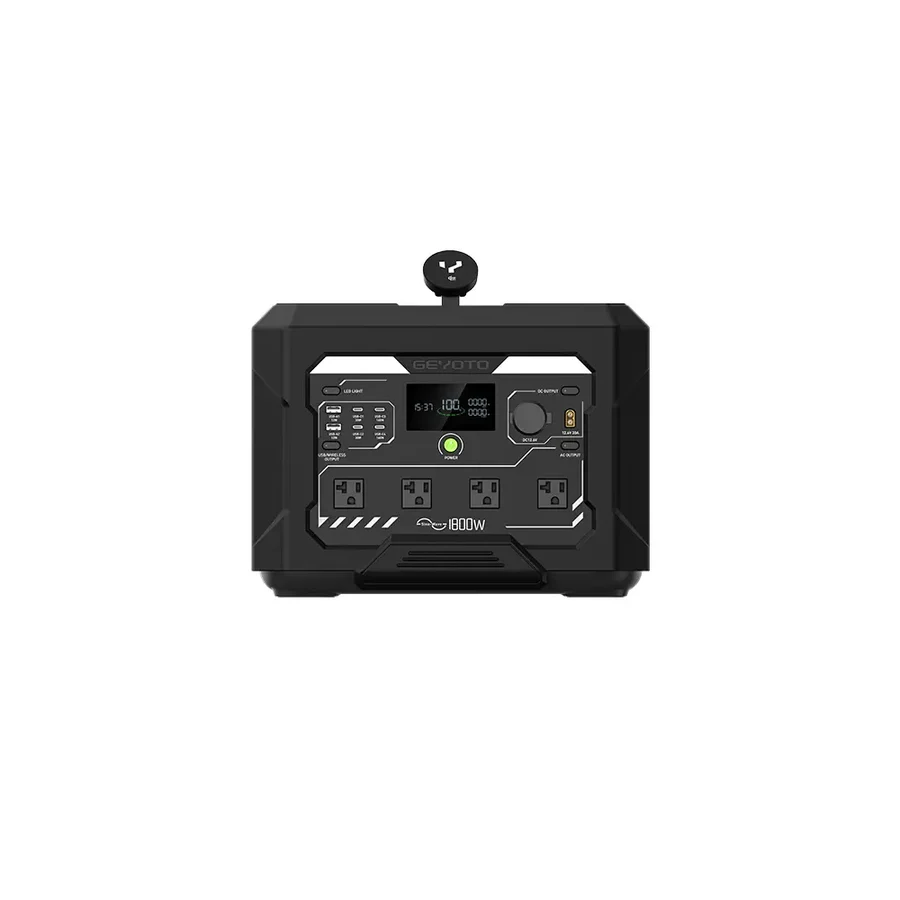
The GEYOTO N1000 provides 1,024Wh of capacity and is designed for higher-capacity applications, including home emergencies, refrigerators, CPAP machines, fans, Wi-Fi equipment, RV trips, camping, and vehicle-support scenarios.
Check Continuous and Peak Output
Capacity tells you how much energy is stored, while output determines how much power the system can deliver at a given time.
The N300 provides 300W of continuous pure sine wave output and 500W peak output. It also has a 550W Constant Power mode for compatible loads within its specified operating conditions.
The N1000 provides 1,800W of continuous pure sine wave output, 3,000W peak output, and a 2,400W Constant Power mode.
When choosing a generator, make sure its continuous output is sufficient for your appliances and that its peak capability can accommodate expected startup demands.
Why Startup Power Matters
Some household appliances consume more power when they initially start. Refrigerators, freezers, pumps, and other motor-driven equipment can have a temporary surge above their normal running wattage.
This is why looking only at an appliance’s standard wattage can lead to an inaccurate assessment. Compare both the running and startup requirements with the generator’s continuous and peak output ratings.
Consider Pure Sine Wave Output
Pure sine wave output provides AC electricity in a waveform similar to utility power. It can be an important consideration for electronics and appliances with specific power requirements.
Both the N300 and N1000 provide pure sine wave output. Even so, users should check the manufacturer’s requirements for individual devices before connecting them to a portable power station.
Evaluate Battery Technology
Battery chemistry can affect the suitability of a portable power station for repeated use.
The N300 and N1000 both use LiFePO4 batteries and are specified for 4,000 cycles. This can be a useful consideration for users who expect to regularly recharge their system.
Actual battery life depends on operating conditions, temperature, charging habits, storage, and usage patterns.
Compare Recharge Times
A generator is most useful when it is ready when you need it. Recharge speed can therefore be important, particularly in areas that experience recurring outages.
The N300 can fully recharge in about 1.5 hours. The N1000 can reach 0–80% charge in 43 minutes and 100% in 68 minutes.
Fast charging can reduce the time between using a backup system and having it ready for the next interruption.
Look at Ports and Interfaces
The number and types of connections determine how conveniently you can use the generator with different equipment.
The N300 has nine output outlets and 25W wireless charging. The N1000 provides 18 total ports and interfaces, including 13 output ports, along with Qi2.2 25W wireless charging.
Consider how many devices you expect to run simultaneously and whether they require AC, USB, DC, wireless, or other types of connections.
Consider UPS Functionality
A UPS, or uninterruptible power supply, can help reduce interruptions when utility power fails.
This feature can be useful for Wi-Fi routers, computers, and other compatible electronics where an unexpected shutdown can interrupt work or connectivity.
Both the N300 and N1000 have a specified UPS switching time of less than 10 milliseconds. Compatibility varies by equipment, so check the requirements of sensitive electronics before depending on UPS operation.
Decide How Much Portability You Need
Generator size should also reflect how and where you plan to use it.
A compact power station may be easier to store, transport, and move between rooms. Larger systems can provide more capacity and output but may require more storage space.
The N300 follows a compact “Grab and Go” positioning, while the N1000 is intended for broader home emergency and outdoor applications.
Consider Multiple Applications
If you plan to use the same system for camping, RV trips, or vehicle-support needs, check whether its outputs support those applications.
The N1000 includes an XT60 vehicle-support output rated at 12.6V/30A, with up to 378W of output for compatible vehicle-support applications.
This type of additional interface can make a portable power station useful beyond emergency home backup.
Traditional Generator or Battery Power Station?
Traditional fuel-powered generators and battery-based portable power stations work differently, and each approach has different considerations.
Fuel-powered generators can provide electricity while fuel is available but require appropriate outdoor operation and ventilation because their engines produce exhaust gases.
Battery-based systems store electricity in advance and can provide portable backup power without an internal combustion engine. They still need to be charged, stored, and operated according to the manufacturer’s instructions.
Your decision should take into account expected outage duration, required power levels, portability, charging availability, and where the system will be used.
Create a Power Priority Plan
A backup system becomes more effective when you know which devices take priority.
For a prolonged outage, refrigeration, communication equipment, essential lighting, and compatible medical equipment may be more important than nonessential appliances. Reducing unnecessary loads can also extend available runtime.
Preparing this priority list before an emergency can make it easier to manage your available energy when the grid goes down.
Safety Considerations
Safety should always be part of generator planning. Fuel-powered generators must be operated outdoors in suitable, well-ventilated locations and should never be used inside homes, garages, or other enclosed spaces because of carbon monoxide risks.
Battery-based power stations do not produce engine exhaust, but they still require proper handling. Follow the manufacturer’s charging, operating, storage, and safety instructions, and never exceed the system’s rated limits.
Emergency Generator Selection Checklist
Before choosing a system, consider:
- Essential loads: Which appliances and devices must remain operational?
- Capacity: How much stored energy is needed?
- Continuous output: Can the system handle the normal running load?
- Peak output: Can it accommodate startup requirements?
- Battery type: Is the battery technology suitable for your expected usage?
- Cycle life: How frequently will the system be recharged?
- Recharge speed: How quickly can it be prepared for another outage?
- Ports: Are there enough suitable connections?
- UPS capability: Do your electronics benefit from reduced switching interruptions?
- Portability: Can you conveniently store and move the system?
Final Thoughts
Choosing an emergency generator is ultimately about matching the system to your actual power requirements. A compact unit can be practical for small electronics, lighting, networking equipment, and short-term backup, while a higher-capacity system can support a broader range of household needs.
By evaluating capacity, output, startup demands, battery technology, recharge speed, ports, UPS functionality, portability, and safety requirements, you can build a backup power setup that is better suited to your household and the outages you are most likely to experience.