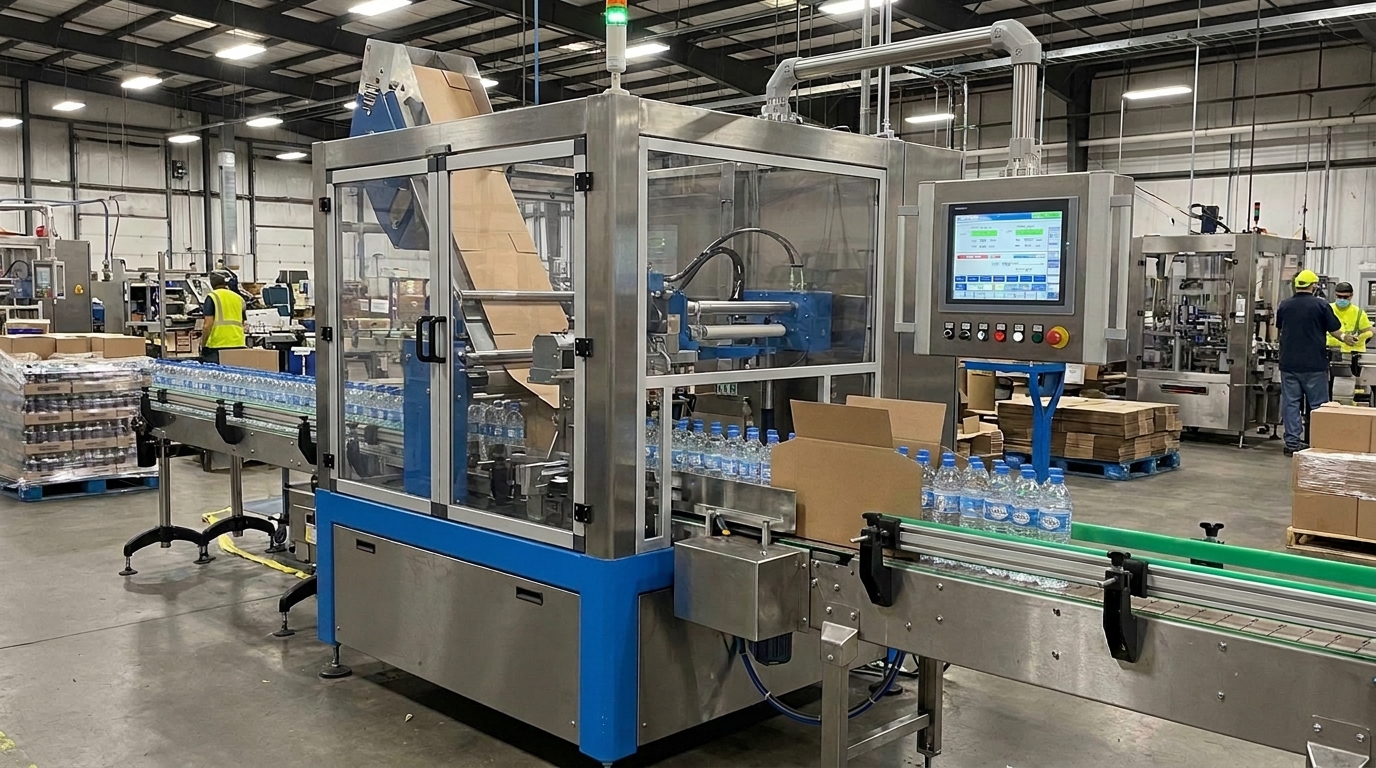
Integrating secondary packaging equipment with palletizing automation helps manufacturers create a smoother end-of-line operation. Instead of treating case packing and palletizing as separate processes, the equipment works as a coordinated system that moves finished cases from packaging to stable pallet loads.
A wrap around case packer forms and closes corrugated cases around grouped products before transferring them toward the palletizing area. The integration requires careful attention to conveyor layout, case spacing, machine speeds, sensors, controls, and communication between both systems.
What Happens Between Case Packing and Palletizing?
Once the case packer completes a case, an outfeed conveyor carries it toward the palletizing system. This conveyor provides more than simple transportation. It helps maintain the correct case orientation, spacing, and flow required by the palletizer.
A well-designed line prevents cases from arriving too quickly or too slowly. Accumulation conveyors may also provide temporary buffering when the palletizer pauses while completing a pallet layer.
The overall sequence typically follows this path:
- Products enter the case packing machine.
- The machine groups and wraps the products with corrugated material.
- The completed case moves onto the discharge conveyor.
- Sensors track case position and spacing.
- The palletizing system receives each case according to its programmed pattern.
- The palletizer places cases onto the pallet layer by layer.
- The completed pallet moves toward wrapping, storage, or shipping.
Why Conveyor Integration Matters
The conveyor between the case packer and palletizer must match the operating requirements of both machines. Poor conveyor design may create gaps, collisions, unnecessary accumulation, or inconsistent case positioning.
Engineers normally consider conveyor speed, case dimensions, transfer points, accumulation capacity, and available floor space. The system also needs suitable guides and controls to keep cases aligned during movement.
Case orientation deserves particular attention. A palletizer may require cases to enter in a specific direction so its robotic arm or mechanical handling system can place them correctly.
Matching Machine Speeds
Speed matching helps prevent one machine from becoming a bottleneck for the entire packaging line. The case packer should supply cases at a rate that the palletizing system can consistently handle.
For example, a high-speed case packer connected to a slower palletizer may require accumulation space between the machines. This buffer allows the case packer to continue operating for a short period while the palletizer catches up.
The opposite situation also matters. A palletizer that operates faster than the case packer may spend time waiting for new cases. Proper line planning helps manufacturers choose equipment capacities that work together efficiently.
Using Sensors and Control Systems
Sensors provide the feedback needed to coordinate case movement. Photoelectric sensors, proximity sensors, encoders, and other devices can detect cases and monitor their positions throughout the transfer process.
The control system uses this information to regulate conveyors and coordinate machine actions. Programmable logic controllers, or PLCs, commonly manage signals between different pieces of equipment.
Communication between the case packer and palletizer may cover conditions such as:
- Case ready for transfer
- Conveyor occupied
- Palletizer ready to receive a case
- Accumulation conveyor approaching capacity
- Pallet complete
- Equipment fault or emergency stop
This communication reduces the risk of cases entering the palletizing area at the wrong time.
Designing the Palletizing Pattern
Case dimensions and product arrangements influence the pallet pattern. The palletizer needs accurate information about case length, width, height, weight, and orientation to create stable layers.
Different patterns may improve pallet stability depending on the case design. Some applications use interlocking arrangements, while others prioritize consistent orientation across each layer.
The case packer’s output must therefore support the palletizer’s requirements. Changes in case dimensions or product configuration may require updates to palletizing parameters.
Managing Case Accumulation
Accumulation provides valuable flexibility between two machines that do not always operate at exactly the same rate. A conveyor section can temporarily hold completed cases while the palletizer finishes a layer or responds to another operating condition.
The required accumulation capacity depends on production speed and the expected duration of interruptions. Engineers also need to consider whether cases require controlled spacing or continuous contact during accumulation.
Too little accumulation may cause frequent stops upstream. Excessive accumulation, however, can increase equipment costs and consume valuable floor space.
How Safety Systems Fit Into the Integration
Safety remains a key part of an automated palletizing line. Guards, safety doors, emergency stops, light curtains, scanners, and other protective devices may help control access to moving equipment.
The safety system should account for the entire integrated line rather than treating the case packer and palletizer as isolated machines. A stop command in one area may need to affect conveyors or upstream equipment to prevent additional cases from entering a stopped section.
A qualified automation or machine-integration team should review the complete system layout and applicable safety requirements before commissioning.
Handling Different Case Sizes
Many production facilities run multiple products or package configurations. A flexible integration should accommodate the case sizes and pallet patterns that the facility expects to use.
Changeover requirements may involve conveyor guides, machine recipes, sensor positions, palletizing programs, or case-handling parameters. Automated recipe management can simplify these adjustments and reduce manual setup work.
Techflow Pack designs packaging solutions around practical production requirements, making equipment coordination an important consideration when planning an automated case packing line.
What Should You Consider Before Integration?
Manufacturers should evaluate the complete production process before connecting a case packer to a palletizer. Looking only at individual machine specifications may overlook important interactions between systems.
Key considerations include:
- Case dimensions and weight
- Required production rate
- Conveyor speed and layout
- Accumulation requirements
- Pallet dimensions
- Desired pallet patterns
- Product changeover frequency
- Control-system communication
- Available floor space
- Safety requirements
- Future production expansion
A clear understanding of these factors helps engineers develop an integration plan that supports reliable material flow.
Where Does Pallet Wrapping Fit?
Pallet wrapping often follows palletizing as another end-of-line step. After the palletizer completes a load, a conveyor can transfer the pallet to a stretch wrapping machine or another stabilization system.
The sequence depends on the facility’s packaging requirements. Some operations may also include pallet labeling, inspection, weighing, or other processes before the finished load enters storage or shipping.
Each additional machine adds another point that the control system must coordinate. The complete line therefore benefits from a centralized approach to communication and fault handling.
Benefits of an Integrated End-of-Line System
Connecting case packing with palletizing creates a more continuous material-handling process. Operators do not need to manually move every completed case from one stage to the next.
A properly integrated system may provide:
- More consistent case flow
- Reduced manual handling
- Better use of production floor space
- More predictable pallet patterns
- Easier monitoring of line conditions
- Improved coordination between machines
- Greater potential for automated end-of-line production
The actual benefits depend on the equipment configuration, production volume, product characteristics, and level of automation.
Final Thoughts
Integrating a wrap around case packing machine with a palletizing system requires more than placing two machines next to each other. Conveyors, sensors, controls, accumulation, case orientation, pallet patterns, and safety functions all need to work together as one coordinated process.
A detailed integration plan helps manufacturers avoid bottlenecks and maintain consistent product flow from case formation through completed pallet loads. Techflow Pack can serve as a useful starting point for manufacturers evaluating case packing equipment and planning a more connected end-of-line packaging operation.