Maintenance of underground pipe networks is vital for the functioning of modern cities, but can be disruptive. Typical excavation may involve road closures, the use of heavy equipment, traffic control, and surface re-vegetation. Today, however, engineers are using compact robotic systems to inspect and maintain pipelines that are hard to access.
These “pipe-bots” can be useful to contractors in diagnosing and solving some blockages without having to open up the roadway above, with features including high-torque cutting tools and intelligent CCTV analysis. Look for an expert who can help you with blocked drains in Leeds.
Meet the Pipe-Bots
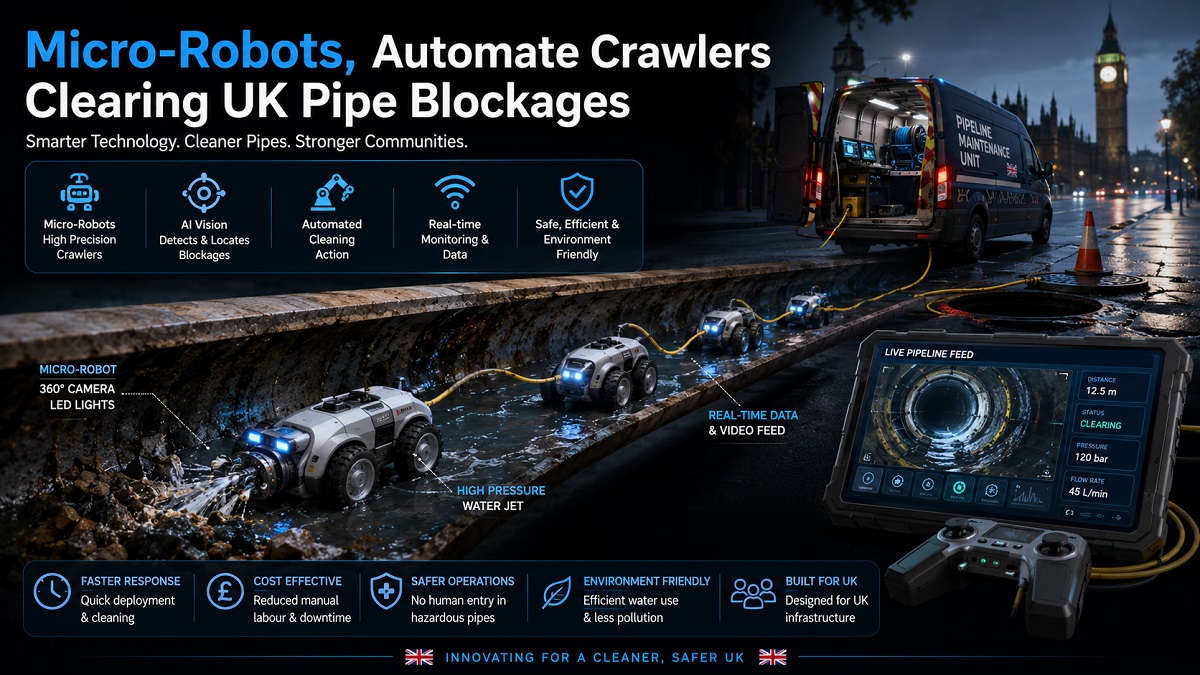
The modern pipe inspection robot is a small robot that can be used to explore underground drainage and sewer systems. They can be controlled remotely or provide automated functions depending on the system.
A number of sophisticated crawlers can transport:
- High-resolution CCTV cameras
- 360-degree imaging systems
- High-torque water-jet cutters
- Mechanical grinders or cutting tools
- Any device that uses sonar or other sensing equipment.
- Technologies for Measurement and localization.
Theirs is their first and most important benefit: accessibility. Sometimes, rather than digging to access a damaged or blocked pipe, engineers can use equipment to access the pipe from an existing hole within the pipe, performing their work directly in the pipe.
This can be of great benefit under dense traffic, commercial zones, and other sites where digging would create significant disturbance.
The Journey from Camera Footage to AI Analysis
Traditionally, inspecting the CCTV was a process that needed trained personnel to watch footage and manually identify the defects. Artificial Intelligence is increasingly playing a role in helping this process.
A computer-vision system can analyse inspection footage and assist in identifying features like:
- Cracks and fractures
- Joint displacement
- Root intrusion
- Corrosion or deterioration
- Deposits and build-up
- Potential fatberg formations
- Changes in pipe geometry
AI isn’t intended to take the place of skilled engineers, but rather to serve as a quick screening and reporting system. It can pinpoint potentially suspicious areas for human inspection and assist in the uniform classification of defects.
This is particularly convenient for huge networks, which might have thousands of hours of footage to examine. Better to learn about the use of technology in managing block toilet before choosing the right professional.
The Robot’s Approach to Solving A “Blockage”
If a blockage has been detected, it can then be tackled with the right robot without any excavation.
For instance, a robot’s system may be capable of dissolving some deposits with high-pressure water cutting. Specific obstructions can be treated with mechanical tools, but cameras can be used for continuous visual feedback.
The process might be like this:
Inspect – Locate – Analyze – Cut/Clear – Reinspect
Once the obstruction is removed, a further CCTV inspection will establish if the pipe is clear and any further defects need to be resolved.
However, robotic clearing isn’t suitable for every situation. Depending on the severity of collapse, extensive structural issues or inaccessibility may still justify excavation or other rehabilitation techniques.
The Financial Advantage
Unnecessary excavation can be a significant saving for councils, utilities and commercial property owners.
Road cut can include:
- Traffic management
- Road closures/lane restrictions
- Excavator and support equipment
- Spoil removal
- Reinstating the asphalt or pavement
- Extended labor requirements
- Public disruption
Many of these costs can be avoided with a targeted robotic intervention, as well as a quicker repair process.
Direct financial savings and indirect economic benefits can accrue to local authorities and water companies with large water systems when a major emergency doesn’t become a long-term roadworks project.
Recommendations for Property Owners and Engineers
If drainage issues recur, you might want to ask for a CCTV survey prior to approval of excavation. A thorough examination will be able to determine if it is a blockage, structural damage, or both.
Also ask contractors:
- Is there access for robotic equipment to the affected area?
- Will there be a post-clearance CCTV survey provided?
- Is the pipe structurally acceptable to use a robot for cleaning?
- What if the blockage exposes a broken pipe?
- Does the contractor have video of inspections available?
While pipe robots are not replacing traditional excavation entirely, they are providing a more precise means of maintenance work that can be accomplished beneath the ground. With robotics, high-tech cameras, AI-powered analysis, and specific cutting techniques, engineers can often troubleshoot issues before swinging a bucket.
It’s important for Britain’s crumbling road infrastructure. Pipe maintenance in the future might be a lesser number of open trenches, fewer disruptions, and more quiet work done under the surface.