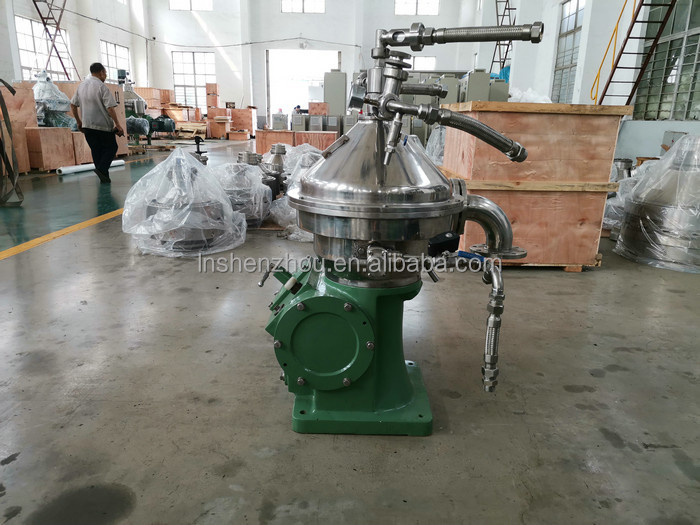
Centrifuge capacity is an important consideration when selecting separation equipment for an industrial process. However, the maximum flow rate of a machine does not always represent the capacity that can be achieved under actual operating conditions.
A Disc Stack Centrifuge can process different types of liquid mixtures, but its practical capacity depends on factors such as feed composition, particle characteristics, viscosity, temperature, and the required separation quality. Understanding these variables helps operators choose suitable equipment and maintain stable performance.
Feed Flow Rate
The incoming feed rate has a direct relationship with centrifuge capacity. Increasing the flow rate reduces the time available for particles or liquid phases to separate inside the bowl.
If the feed rate becomes too high for the application, separation efficiency may decline. More suspended solids can remain in the clarified liquid, or the separated liquid phases may not reach the desired purity.
For this reason, capacity should be evaluated together with the required separation result rather than considered as a standalone number.
Particle Size and Concentration
The characteristics of suspended solids can significantly affect processing capacity. Larger and denser particles are generally easier to separate than very fine particles.
A high concentration of solids can also increase the load on the centrifuge. Depending on the equipment design, excessive solids loading may require more frequent discharge or cleaning.
Processes containing fine particles may therefore need a lower operating flow rate to achieve the desired clarification level.
Density Difference
Density difference plays an important role in centrifugal separation. When the density difference between solids and liquid is relatively large, separation is generally easier.
For liquid-liquid separation, the density difference between the two liquid phases also influences performance. When two liquids have very similar densities, the centrifuge may require more carefully controlled operating conditions.
Liquid Viscosity
Viscosity affects how easily particles and liquid phases move within the centrifuge. Higher-viscosity fluids generally make separation more difficult because they resist movement.
This means a process handling a thick liquid may have a lower practical capacity than a process involving a low-viscosity liquid, even when the equipment is identical.
Temperature can also influence viscosity. In some applications, maintaining an appropriate process temperature can help achieve more consistent separation conditions.
Disc Stack Design
The configuration of the disc stack affects the effective separation area inside the bowl. Closely spaced conical discs create thin liquid layers and reduce the distance particles need to travel before reaching a surface.
The geometry, spacing, and overall design of the disc stack are therefore important factors in determining separation performance.
A suitable disc arrangement can help the centrifuge handle fine suspended particles efficiently, but the optimal configuration depends on the characteristics of the material being processed.
Bowl Speed
Rotational speed determines the centrifugal force generated inside the bowl. Higher centrifugal force can improve the separation of certain fine particles and liquid phases.
However, operating speed must remain within the equipment’s designed limits. It is not simply a matter of increasing speed to obtain greater capacity, as mechanical safety, product characteristics, and separation requirements all need to be considered.
Solids Discharge Capability
The method used to remove accumulated solids can affect continuous processing capacity. If solids build up faster than they can be discharged, the centrifuge may experience reduced performance.
Applications with high solids concentrations may therefore require a discharge system capable of handling the expected solids load without frequent interruptions.
Feed Temperature
Temperature can influence several properties of the feed, particularly viscosity and phase behavior. Changes in temperature may therefore affect both separation efficiency and practical throughput.
For processes where temperature varies significantly, capacity calculations should use realistic operating temperatures rather than laboratory or ambient conditions alone.
Required Separation Quality
Capacity and separation quality are closely connected. A centrifuge may be capable of handling a higher flow rate, but doing so may result in lower clarification or reduced phase purity.
If the process requires very clear liquid or high recovery of a particular phase, the operating flow rate may need to be reduced to provide sufficient separation.
In other words, the highest possible throughput is not necessarily the best operating point.
Feed Pressure and Distribution
Stable feed conditions help maintain predictable performance. Variations in feed pressure or uneven distribution inside the bowl can influence flow patterns and separation behavior.
Pumps, valves, filters, and upstream equipment should therefore be properly matched to the centrifuge. Consistent feed conditions can make it easier to maintain a stable processing rate.
Equipment Condition
The condition of the centrifuge itself can also influence practical capacity. Accumulated deposits, worn components, improper assembly, or mechanical problems may reduce separation performance.
Regular cleaning and preventive maintenance can help keep the equipment operating closer to its intended performance range.
Shenzhou Machinery is one supplier of centrifugal separation equipment, but actual capacity should always be determined according to the specific machine configuration and process conditions.
How to Determine Practical Capacity
When evaluating capacity, operators should consider the complete process rather than relying only on the manufacturer’s maximum flow specification.
Important information includes:
- Feed composition and solids concentration
- Particle size and density
- Liquid viscosity
- Operating temperature
- Required separation efficiency
- Expected solids discharge rate
- Continuous operating hours
- Desired product quality
Pilot testing or trials with representative process material can provide a more realistic indication of achievable throughput when the separation characteristics are uncertain.
Conclusion
The capacity of a disc stack centrifuge is influenced by much more than bowl size or rated flow rate. Feed properties, particle characteristics, density differences, viscosity, temperature, disc stack design, rotational speed, solids discharge, and required separation quality can all affect practical throughput.
Understanding these factors allows process engineers and operators to establish realistic operating conditions. By balancing throughput with separation performance, a centrifuge can provide more consistent results while avoiding unnecessary strain on the equipment.