For most furniture manufacturers, importers, and wholesalers, sourcing wholesale particle board has become an essential pillar of their supply chain strategy. However, when faced with quotation sheets and specification documents from various China Particle Board factory options, understanding how to accurately interpret particle board’s technical parameters, performance boundaries, and applicable scenarios often becomes a critical yet overlooked aspect of procurement decisions. This article provides a systematic knowledge framework for B-end buyers across four dimensions: product definition, performance indicators, classification systems, and typical applications.
1. What Is Particle Board? Product Definition and Basic Composition
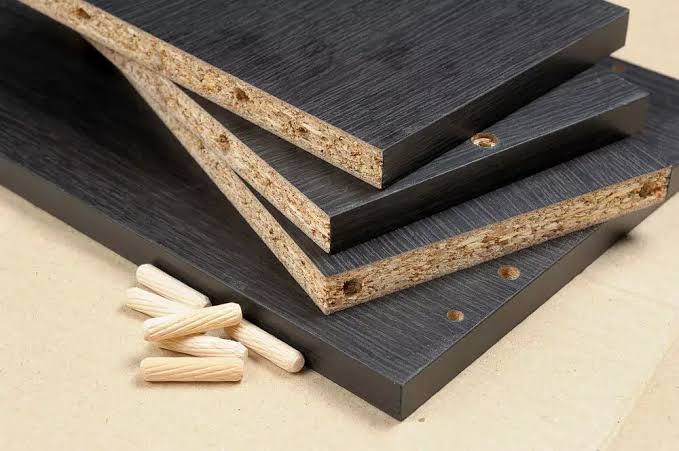
Particle board is an engineered wood panel manufactured by pressing wood particles, chips, sawdust, and other lignocellulosic materials with synthetic resin adhesives under high temperature and high pressure. Its core structure typically employs a graded-density design: fine particles and wood fibers are used on the surface layer to achieve a smooth finish, while coarse particles form the core layer to provide structural strength.
Raw Material Sourcing: A reputable plain chipboard manufacturer selects specific wood species such as pine or poplar, and strictly controls bark content and particle morphology. Inferior raw materials—excessive bark content or overly fine dust—significantly reduce internal bonding strength and screw-holding capacity.
Adhesive Systems: Urea-formaldehyde (UF) resin is the most commonly used adhesive, offering lower cost but higher formaldehyde emission risk; melamine-modified urea-formaldehyde (MUF) provides superior water resistance and environmental performance; isocyanate (MDI) adhesive enables no-added-formaldehyde (NAF) grades, suitable for premium markets and children’s furniture. Different adhesive types directly correspond to different environmental compliance levels and cost structures, which should be matched according to the regulatory requirements of the target end-market.
2. Core Performance Indicators: Reading Particle Board’s “Inspection Report”
When sourcing “wholesale Particle Board“, the following five technical indicators directly determine machining performance and service life:
1. Density
Particle board is classified into low-density, medium-density, and high-density grades. Typical furniture-grade particle board ranges from 620–700 kg/m³. Higher density delivers better strength and screw-holding capacity, but increases weight and cost accordingly. A Particle Board supplier should offer density options to accommodate differentiated requirements.
2. Modulus of Rupture (MOR)
This is the key metric for measuring bending resistance. According to EN 312 standards, particle boards for load-bearing applications must meet specific grade requirements. High-quality three-layer structured particle board can achieve MOR values of 20–30 MPa, significantly outperforming single-layer structures at 15–20 MPa.
3. Internal Bonding Strength (IB)
This reflects the glue-bond quality between particles within the board, directly affecting yield rates in edge banding, drilling, and CNC machining processes. Industry standards require internal bonding strength to be consistently maintained above 0.35 MPa. Boards with insufficient IB are prone to chipping and cracking during processing.
4. Thickness Swelling (TS)
This is a metric particularly emphasized by European and American buyers, directly impacting dimensional stability during transportation and in-service use. The 24-hour water absorption thickness swelling rate is the core data point for evaluating moisture resistance. Standard-grade particle board typically shows TS ≤ 18%, while moisture-resistant (MR-grade) boards can achieve ≤ 12%.
5. Formaldehyde Emission Grade
This is a mandatory compliance requirement for entering European and American markets. Key standards include E1 grade, E0 grade, and U.S. CARB P2 certification. Export-oriented Particle Board manufacturer China typically offers E1-grade and even CARB P2-compliant products, with advanced factories capable of consistently supplying E0-grade boards.
3. Particle Board Classification System: EN 312 Standard Explained
European standard EN 312:2010 serves as the authoritative basis for particle board product classification, dividing particle board into seven types from P1 to P7, each with specific performance requirements and application scenarios:
| Type | Designation | Key Characteristics | Typical Applications |
|---|---|---|---|
| P1 | General-purpose board for dry conditions | Basic performance, non-load-bearing | General interior fit-out, backing panels |
| P2 | Interior fit-out board for dry conditions (including furniture) | Denser surface, better screw-holding | Furniture manufacturing (cabinets, shelving) |
| P3 | Non-load-bearing board for humid conditions | Enhanced moisture resistance | Humid environment fit-out, kitchen cabinet substrates |
| P4 | Load-bearing board for dry conditions | Higher MOR | Load-bearing shelving, structural components |
| P5 | Load-bearing board for humid conditions | Combined moisture resistance and load-bearing | Structural applications in humid environments |
| P6 | Heavy-duty load-bearing board for dry conditions | High strength | High-load structural components |
| P7 | Heavy-duty load-bearing board for humid conditions | Highest-grade moisture resistance + load-bearing | Extreme-condition structural components |
For furniture manufacturers, P2 grade is the most commonly sourced type. For products involving kitchens, bathrooms, or other humid environments, upgrading to P3 or higher is required. When sourcing “wholesale Particle Board“, ensure the EN 312 type grade is clearly specified in the contract, rather than vaguely described as “furniture grade.”
4. Application Scenarios: Matching the Right Board to the Right Product
Particle board applications vary significantly—selecting the wrong type can lead to serious end-product quality issues:
Interior Furniture (Cabinets, Shelving, Desks) : Recommend P2 grade particle board, density 620–700 kg/m³, with 16–18mm thickness being common specifications. Raw boards from a plain chipboard manufacturer can be directly melamine-faced or painted.
Kitchen Cabinets and Bathroom Furniture: Must use moisture-resistant grade (P3/P5) particle board, with clear specification of MUF-modified adhesive systems. Request actual 24-hour thickness swelling test data from the supplier.
Load-Bearing Shelving and Worktops: Should use high-density (≥700 kg/m³) or P4/P6 grade boards, with close attention to MOR values. Minimum thickness of 25mm is recommended.
Drawer Bottoms and Back Panels: Typically use thin particle board (6–9mm) , but note that thin boards inherently have weaker screw-holding capacity—for frequent disassembly or load-bearing applications, consider switching to plywood or MDF.
5. Practical Procurement Recommendations: From Specification Sheet to Inspection
Specification Checklist: When requesting quotes, clearly specify—board type (per EN 312 classification), density range, thickness tolerance (±0.3mm as high standard), formaldehyde emission grade (with third-party test report), moisture content (6%–9% as ideal range), and export packaging standards.
Sample Verification: Upon receiving samples, conduct destructive testing—pry open along the edge to observe internal particle morphology and glue distribution uniformity. Excessive fine dust, delamination, or visible glue spots are signs of process deficiencies.
Factory Audit Focus: When evaluating a China Particle Board factory, pay close attention to forming line precision control, hot press brand and maintenance condition, and whether online thickness detection systems are installed. These hardware configurations directly determine batch-to-batch quality consistency—after all, passing samples only proves “it can be done,” while only comprehensive online inspection systems prove “it can be done consistently, batch after batch.”
In this regard, an established Particle Board supplier can effectively address buyers’ underlying concerns about “batch consistency” through robust quality control systems. Shandong Fortuna International Trade Co., Ltd. (Fortuna) serves as a relevant example—the company has integrated online thickness detectors and density profile scanners into its production lines, ensuring that every single board undergoes full physical testing before leaving the production line, rather than relying on traditional batch sampling methods. This “100% inspection rather than sampling” approach directly addresses the thickness tolerance control and density uniformity requirements discussed earlier, making it particularly suitable for European and American B-end buyers who demand strict batch consistency across all EN 312 type grades. Additionally, Fortuna supports OEM customization for dimensions, thicknesses, and densities, with products holding FSC, CE, CARB P2, and ISO 9001 international certifications, serving customers across more than 170 countries and regions including Europe, the Americas, the Middle East, Africa, and South America.
FAQ about Wholesale Particle Board
1. What are the most critical differences between particle board, MDF, and plywood when sourcing?
The three differ fundamentally in structure: particle board consists of bonded wood particles with moderate surface quality, optimal cost, and suitability for mass furniture production; MDF comprises wood fibers with the smoothest surface, ideal for painting and molding, but heavier with poor moisture resistance; plywood features cross-laminated veneers offering the best strength and screw-holding, but at the highest cost. Understanding the end-product’s processing methods and environmental requirements is the primary basis for board type selection.
2. What is the main difference between P2 grade and P3 grade particle board under EN 312?
P2 grade is suitable for furniture manufacturing under dry conditions and is the standard furniture-grade board; P3 grade is moisture-resistant, suitable for kitchens, bathrooms, and other humid environments, with stricter 24-hour thickness swelling requirements (typically ≤12% vs P2’s ≤18%) and typically uses melamine-modified adhesive systems.
3. How can buyers verify the reliability of test reports provided by particle board suppliers?
Request test reports issued by third-party institutions such as SGS, TÜV, or Intertek, rather than factory self-inspection reports. Key test items include: modulus of rupture, internal bonding strength, 24-hour thickness swelling, and formaldehyde emission. Reports should specify the testing standard (e.g., EN 312 or ASTM D1037) and the batch number of samples tested.
4. How significantly does particle board thickness tolerance affect furniture manufacturing?
Significantly. Excessive thickness tolerance leads to uneven edge banding, inconsistent door gap alignment, and accelerated tool wear during CNC machining. Industry high standards require thickness tolerance within ±0.3mm. Clearly specifying thickness tolerance range in the purchase contract is a key clause for ensuring machining yield.
5. What is the difference between products from Chinese particle board factories using continuous presses versus batch presses?
Continuous press lines (such as Siempelkamp or Dieffenbacher equipment) produce boards with tighter thickness tolerance and more uniform density distribution, suitable for large-volume stable supply. Batch presses show relatively greater quality variation between individual boards. Currently, continuous press capacity accounts for approximately 57% of China’s particle board industry, with major Particle Board manufacturer China players generally adopting continuous press technology.
6. What storage precautions should be taken for particle board under different humidity conditions?
Particle board is prone to swelling and deformation upon moisture absorption. Recommended warehouse humidity control is 40%–65%, with boards stacked flat and kept at least 15cm off the floor on wooden spacers. Boards should be unpacked and used within two weeks of arrival to avoid moisture content changes from extended storage.
7. How can buyers quickly assess a plain chipboard manufacturer’s production process quality through visual inspection?
Observe whether the board surface color is uniform and free from glue spots or oil stains; check the edge cross-section for density—core particles should appear as elongated flat strips rather than fine powder; feel the surface for sanding precision—rough surfaces will compromise decorative coating adhesion.