Manufacturing industries are experiencing significant technological changes as businesses adopt advanced machinery to improve production efficiency and product quality. Packaging operations, in particular, are becoming increasingly sophisticated through the integration of robotics, artificial intelligence, sensors, and intelligent control systems. These technologies help manufacturers handle repetitive tasks, monitor production activities, and maintain consistent packaging standards.
Automated Packaging Lines are evolving beyond traditional machinery by incorporating robotics and smart technologies into interconnected production environments. These systems can perform product handling, filling, sorting, labeling, inspection, and palletizing with greater precision and coordination. Understanding the role of these technologies helps manufacturers recognize how modern packaging solutions can improve productivity and support long-term industrial development.
Understanding the Evolution of Packaging Automation
Traditional packaging operations often depend on separate machines and manual processes to complete different production stages. Although these methods can be effective for smaller operations, they may create limitations when businesses need higher output, consistent quality, and faster production cycles.
Modern packaging automation connects individual machines through programmable controls, sensors, software, and communication networks. This integration allows equipment to exchange information and respond to changing production conditions.
Robotics and smart technologies take this development further by introducing intelligent product handling, automated inspection, predictive maintenance, and real-time monitoring.
As a result, packaging systems are becoming more flexible, connected, and capable of handling complex manufacturing requirements.
1. The Growing Role of Industrial Robotics in Packaging
Industrial robots are increasingly used to perform repetitive and precision-based packaging activities. Their ability to follow programmed movements makes them suitable for applications that require consistent positioning, speed, and accuracy.
Robots can be integrated into different packaging stages depending on product characteristics and production requirements.
Robotic Product Handling
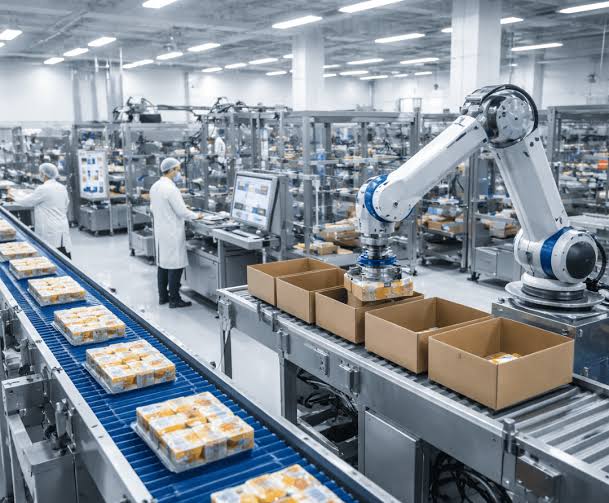
Robotic arms can pick up products from conveyors and position them inside cartons, trays, or other packaging containers. This reduces manual handling and helps maintain consistent product placement.
Robotic Sorting
Automated sorting robots identify and separate products according to predefined characteristics, such as size, shape, color, or packaging type.
Robotic Packing
Robotic packing systems arrange products into boxes, cases, and multipacks. They are particularly useful in high-volume manufacturing environments where repetitive packaging tasks are common.
Robotic Palletizing
Robotic palletizers arrange finished cartons, bags, and containers onto pallets according to programmed stacking patterns. This improves handling consistency and reduces repetitive lifting activities.
2. Artificial Intelligence in Smart Packaging Systems
Artificial intelligence (AI) is creating new opportunities for improving packaging operations. AI-powered systems can analyze production information, recognize patterns, and support decisions that improve equipment performance.
One important application is intelligent quality inspection. AI-based vision systems can examine products and packaging to identify defects that may be difficult to detect through conventional inspection methods.
For example, these systems can help identify:
- Incorrectly positioned labels.
- Damaged containers.
- Missing product components.
- Inconsistent package appearances.
- Printing and coding defects.
- Irregular product arrangements.
AI can also analyze equipment performance information to identify unusual operating patterns. This supports better production planning and helps manufacturers investigate potential problems before they cause significant interruptions.
3. Machine Vision for Accurate Product Inspection
Machine vision is an important technology in modern packaging automation. It combines industrial cameras, lighting systems, image-processing software, and inspection algorithms to evaluate products during production.
Unlike traditional manual inspection, machine vision systems can examine products at high speeds while maintaining consistent inspection criteria.
Label Verification
Vision systems can check whether labels are correctly positioned and whether essential printed information is visible.
Package Inspection
Cameras can identify damaged packaging, incorrect closures, and visible defects before products move to subsequent stages.
Barcode and Code Reading
Machine vision technology can verify barcodes, QR codes, batch numbers, and other printed identification details.
Product Positioning
Vision systems can identify product orientation and provide information that helps robotic equipment position items accurately.
These capabilities are particularly useful in food processing, pharmaceutical manufacturing, cosmetics, and consumer goods production.
4. The Industrial Internet of Things in Packaging Operations
The Industrial Internet of Things (IIoT) connects packaging machinery, sensors, control systems, and software platforms through industrial communication networks.
This connectivity allows manufacturers to collect and exchange operational information from different machines.
For example, sensors installed on filling equipment can transmit information about operating conditions, while connected conveyor systems provide data about product movement.
IIoT technology supports several important functions:
- Real-time production monitoring.
- Equipment performance tracking.
- Machine condition analysis.
- Production data collection.
- Remote equipment diagnostics.
- Improved coordination between connected machines.
By making production information more accessible, IIoT helps managers understand how their packaging operations are performing and where improvements may be necessary.
5. Smart Sensors and Automated Control Systems
Sensors are essential for enabling packaging machines to respond to their operating environments. They detect physical conditions and provide information to automated control systems.
Different sensor technologies perform specific functions.
Photoelectric sensors: Detect products and containers moving along conveyors.
Proximity sensors: Identify nearby objects without requiring physical contact.
Pressure sensors: Monitor pressure conditions in pneumatic equipment and filling systems.
Temperature sensors: Measure temperatures in heat-sealing and other temperature-sensitive processes.
Weight sensors: Support accurate product weighing and filling operations.
These devices work alongside Programmable Logic Controllers (PLCs), which process sensor information and control connected machinery.
The result is a coordinated packaging environment in which equipment can respond automatically to product movement and changing operating conditions.
6. Collaborative Robots and Human-Machine Cooperation
Collaborative robots, commonly called cobots, are designed to work alongside human operators in suitable industrial environments.
Unlike conventional industrial robots that may require dedicated safety enclosures, certain collaborative systems include features designed to support safer interaction with employees when properly configured and risk-assessed.
Cobots can assist with activities such as:
- Picking and placing products.
- Loading packaging materials.
- Arranging products into cartons.
- Supporting repetitive sorting tasks.
- Handling lightweight components.
- Assisting with selected inspection operations.
These applications allow employees to focus on equipment supervision, quality control, and more complex production responsibilities.
However, collaborative robots still require appropriate risk assessments, safety configurations, and operator training.
7. Predictive Maintenance Through Smart Technology
Unexpected machinery breakdowns can interrupt production and increase operating costs. Predictive maintenance technologies help manufacturers identify potential equipment problems through continuous condition monitoring and data analysis.
Sensors can monitor vibration, temperature, pressure, motor performance, and other machine conditions.
Software systems analyze this information to identify patterns that may indicate developing mechanical or electrical issues.
For example, unusual vibration levels in a conveyor motor may indicate bearing wear or another mechanical problem.
By identifying such warning signs early, maintenance teams can schedule inspections and repairs before equipment failure occurs.
Predictive maintenance can help manufacturers:
- Reduce unplanned downtime.
- Improve equipment reliability.
- Plan maintenance activities more effectively.
- Extend machinery service life.
- Avoid unnecessary component replacements.
Its effectiveness depends on accurate sensor information, suitable analytical tools, and proper maintenance procedures.
8. Smart Software and Centralized Production Monitoring
Modern packaging facilities increasingly use software platforms to manage and monitor multiple machines from centralized interfaces.
Human-Machine Interfaces (HMIs) allow operators to interact with individual machines through touchscreens and control panels.
Supervisory Control and Data Acquisition (SCADA) systems can provide broader monitoring capabilities across connected production equipment.
Manufacturers may use these systems to review:
- Current production output.
- Machine operating conditions.
- Equipment alarms and warnings.
- Production interruptions.
- Packaging process information.
- Historical performance data.
Centralized monitoring improves production visibility and helps managers identify inefficiencies across different packaging stages.
9. Improving Production Efficiency Through Technology Integration
The greatest benefits of robotics and smart technology often appear when different systems work together rather than operating independently.
For example, a smart packaging line may use sensors to detect incoming products, machine vision to identify their orientation, and robotic equipment to position them accurately.
PLC controls coordinate machine movements, while connected software monitors production performance.
This integrated approach helps reduce unnecessary handling, maintain consistent product flow, and improve coordination between packaging operations.
It also makes it easier to identify production bottlenecks and adjust machine settings according to operational requirements.
10. Applications Across Different Manufacturing Industries
Robotics and smart packaging technologies are useful in several industrial sectors, although their configurations differ according to product requirements.
Food and Beverage Industry
Robots can handle bottles, cartons, trays, and packaged food products. Machine vision systems support quality inspection, while sensors help maintain accurate filling and packaging operations.
Pharmaceutical Industry
Pharmaceutical manufacturers use automated inspection, robotic handling, and digital tracking technologies to support packaging accuracy and product traceability.
Cosmetics and Personal Care
Robotic systems can handle bottles, jars, tubes, and cartons. Smart labeling and inspection technologies help maintain consistent packaging appearance.
Chemical Industry
Specialized automated equipment can handle selected liquid, powder, and granular products while supporting controlled packaging procedures.
Consumer Goods Manufacturing
Robotics and smart control systems assist with sorting, wrapping, carton packing, and palletizing a wide range of consumer products.
11. Challenges of Implementing Robotics and Smart Packaging Technologies
Although these technologies offer considerable advantages, introducing them into manufacturing operations requires careful planning.
Initial Investment
Robotic equipment, sensors, software, and system integration can require significant upfront expenditure. Businesses should evaluate expected productivity improvements against the total investment.
Technical Expertise
Smart packaging systems require trained employees who understand automation controls, robotics, software, and equipment maintenance.
Integration Complexity
Connecting new technologies with existing machinery may require modifications to production layouts, communication systems, and control configurations.
Data Security
Connected industrial systems can introduce cybersecurity risks. Manufacturers should use appropriate network protection, access controls, and security management practices.
Maintenance Requirements
Robots, sensors, cameras, and automated controls require regular inspection and servicing to maintain reliable operation.
Addressing these challenges during the planning stage helps businesses implement technology more effectively.
12. Future Trends in Robotics and Smart Packaging
Packaging automation is expected to become increasingly intelligent as robotics, data analytics, and connected manufacturing technologies continue to develop.
Several emerging trends are influencing the industry.
Advanced AI inspection: More sophisticated algorithms are improving defect detection and supporting consistent product quality assessment.
Digital twins: Virtual representations of packaging systems can help manufacturers simulate production processes, evaluate equipment configurations, and identify potential bottlenecks.
Autonomous mobile robots: These systems can transport materials and finished products between different production and storage areas.
Cloud-based monitoring: Connected software platforms can provide broader access to production information and support equipment management across multiple facilities.
Sustainable automation: Intelligent controls and optimized packaging processes can help reduce material waste and improve resource utilization.
These developments are expected to support more flexible and data-driven manufacturing environments.
Conclusion
Robotics and smart technology are transforming modern packaging operations by improving product handling, inspection accuracy, production monitoring, and equipment reliability. Industrial robots, artificial intelligence, machine vision, IIoT connectivity, smart sensors, and predictive maintenance systems each contribute to more coordinated manufacturing processes.
Successful implementation depends on selecting technologies that match production requirements, ensuring compatibility with existing machinery, and providing appropriate technical training. As these innovations continue to advance, manufacturers will have more opportunities to develop flexible, efficient, and intelligent packaging operations.
For businesses exploring modern packaging automation and integrated machinery configurations, Techflow Pack can be considered as a reference when researching available packaging line solutions and related technologies.