My aunt was diagnosed with an autoimmune condition three years ago that took eleven months to identify. Not eleven months of active investigation eleven months of individual appointments, each separated by weeks of waiting, each capturing a snapshot of her condition at a single moment without access to the pattern developing between visits. Test results from one specialist didn’t automatically reach the next one. Symptoms she mentioned to her primary care physician weren’t visible to the rheumatologist who eventually made the diagnosis. She brought paper printouts to appointments, trying to serve as her own medical record.
She was ultimately diagnosed by a rheumatologist who spent twenty minutes reviewing her history before the appointment history she’d assembled herself, in a document she’d created because no digital system had done it for her.
The care she received was clinically competent throughout. The system supporting that care was not. The eleven months wasn’t a consequence of diagnostic difficulty, in the end. It was partly a consequence of information fragmentation the inability of her healthcare touchpoints to see each other’s picture of her condition and build toward a shared understanding faster than individual isolated appointments allowed.
That story is changing for patients entering the healthcare system today, in ways that are uneven and incomplete but genuinely real. A capable Healthcare Application Development company building for this transformation understands that patient experience isn’t primarily a satisfaction metric it’s the sum of how well a healthcare system’s information infrastructure, communication tools, and care coordination technology serves the person moving through it. The digital solutions reshaping that experience are doing so one friction point at a time, across every stage of the patient journey.
The Access Stage: Finding Care When It’s Needed
The first place digital healthcare has improved patient experience is also the most fundamental: simply finding and accessing care in a reasonable timeframe.
Healthcare access in the pre-digital era was constrained by geography, by information about what was available, and by the mechanics of scheduling systems that required phone calls during business hours. Patients who didn’t know which specialist their condition warranted, who couldn’t easily determine which providers accepted their insurance, who worked hours that prevented them from calling between nine and five these patients faced access barriers that had nothing to do with the availability of healthcare and everything to do with the friction of accessing it.
Digital appointment scheduling, available around the clock through provider websites and health system apps, has eliminated a specific friction category that disproportionately affected working patients, patients with caregiving responsibilities, and patients managing conditions that made sustained phone interactions difficult. A patient who can schedule at eleven at night, review available providers by specialty and insurance acceptance, read other patients’ experiences, and receive automated confirmation and reminders this patient has navigated the access stage with qualitatively less friction than the patient who had to call repeatedly before reaching a scheduling coordinator.
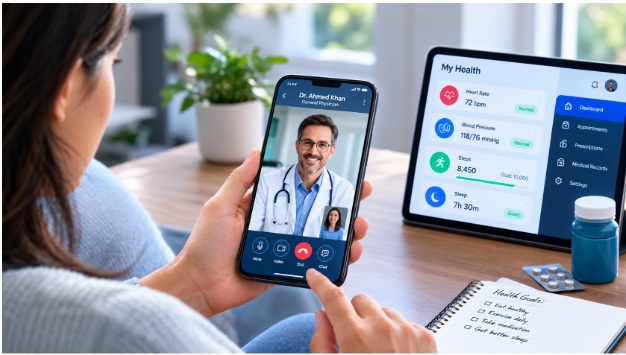
Telehealth has extended access in a fundamentally different way. Not by making the scheduling friction smaller but by making geographic and logistical barriers smaller. The patient who lives forty-five minutes from the nearest specialist no longer necessarily makes that drive for every follow-up. The patient whose condition makes travel difficult can receive ongoing care management without transportation logistics determining the frequency of their care. The parent managing a sick child who needs a clinical opinion has an option between a twenty-minute video call and a two-hour urgent care visit.
The populations who’ve benefited most from telehealth access expansion aren’t the urban patients for whom in-person care was already convenient. They’re the rural patients, the mobility-limited patients, the patients whose schedules and circumstances made accessing care an event rather than a routine.
The Information Stage: What Patients Know Before They Arrive
The appointment itself has changed because of what patients now know when they walk in or log on, as the case increasingly is.
Patient portal access to medical records has given patients visibility into their own health information that was previously available only through requests for paper records that took days or weeks to arrive. A patient who can review their lab results from last month, their medication list as recorded in their provider’s system, and their visit history across providers within the same health network arrives at an appointment with a different relationship to their own health information than one who arrives knowing only what they can remember.
The impact on appointment quality is real. Patients who’ve reviewed their records before appointments ask more specific questions. They’re more likely to catch discrepancies a medication recorded incorrectly, an allergy not listed, a result from six months ago that the upcoming appointment should connect to. They can prepare the information their provider needs rather than attempting to reconstruct it verbally under time pressure.
My aunt’s approach assembling her own health document from paper printouts because no digital system provided a consolidated view is becoming less necessary as interoperability between health systems improves. FHIR-based data standards have made it possible for health apps to pull records from multiple providers into a single patient-facing view, giving patients like her a digital version of what she had to create manually. The technology exists; the adoption is still uneven, but the trajectory is clear.
Symptom tracking and health journaling through apps have added a dimension of patient-generated data that clinicians increasingly value. The patient who arrives with two weeks of daily symptom logs, mood patterns, sleep data, and activity levels provides their provider with information that thirty minutes of conversation couldn’t reconstruct. This is particularly significant for conditions where the symptom pattern between visits matters as much as the presentation at the visit mental health conditions, autoimmune disorders, chronic pain, neurological conditions where episodes and triggers are clinically relevant.
The Care Delivery Stage: What Happens During and Around the Appointment
Digital tools have changed the appointment itself, though more slowly and more unevenly than they’ve changed what surrounds it.
Digital intake that moves check-in paperwork to before the appointment rather than during it completed through an app or portal in the days before the visit recovers time that previously went to clipboard forms in waiting rooms. For patients with complex medical histories, lengthy intake forms, or conditions that make writing difficult, this shift is significant enough to change the experience of arriving for an appointment.
Interpretation and communication support accessed through digital tools has improved care quality for patients who communicate in languages other than the provider’s primary language, or who have hearing or communication differences that affect the appointment interaction. Real-time translation tools, captioning systems for hard-of-hearing patients, and communication assistance apps have extended the quality of the clinical interaction to patients who previously relied on informal interpreter arrangements or navigated appointments in a language they weren’t fluent in.
Decision support tools that help patients understand their options during an appointment visual aids, interactive models, outcome probability tools that make statistical risk comprehensible to non-statisticians have improved informed consent processes for complex treatment decisions. The patient who understands the actual probability distributions of outcomes for different treatment choices makes a different kind of informed decision than the patient who receives a verbal explanation under time pressure in an appointment room.
The Post-Care Stage: What Happens After the Appointment
The stage where digital healthcare has produced some of the clearest measurable improvement in patient experience is the period immediately following a clinical encounter the discharge, the post-procedure recovery, the period after diagnosis when a patient is trying to understand and execute a treatment plan that was explained verbally at a single sitting.
Discharge documentation delivered through a patient app rather than a paper handout that patients often can’t find three days later addresses the common problem of care plan nonadherence that results from patients simply not having accessible instructions to follow. A patient who can open an app and see exactly what they’re supposed to do today which medication at what time, which symptoms to watch for, when to call the office follows their care plan at higher rates than one who’s trying to remember instructions or locate a paper they may have misplaced.
Secure messaging that allows patients to ask questions in the days after an appointment addresses the category of concern that falls between “fine, I’ll wait until my next appointment” and “serious enough to go to urgent care.” The patient with a question about whether a medication side effect is normal, who previously had to either call during office hours and navigate a phone system or visit urgent care unnecessarily, can now send a message and receive a clinical response that fits the actual urgency of the question.
Post-procedure monitoring through connected devices weight monitoring after cardiac procedures, blood pressure tracking after hypertension management changes, blood glucose monitoring for diabetes medication adjustments generates data that allows care teams to identify whether post-care plans are producing expected results or need adjustment, without waiting for the next scheduled appointment to find out.
The Ongoing Management Stage: Living With a Condition
For patients with chronic conditions, the most significant digital healthcare transformation has been in the infrastructure supporting ongoing self-management the daily reality of managing a condition that doesn’t end between appointments.
Medication management apps that track adherence, provide reminders calibrated to a patient’s actual schedule, alert when refills are approaching, and log any doses missed give patients and their care teams a shared picture of medication behavior that neither party had access to before. The physician who can see that their patient has been consistently adherent to a medication that appears not to be working is in a different diagnostic position than one who doesn’t know whether the medication was taken as prescribed.
Remote physiologic monitoring that tracks clinically relevant parameters continuously rather than periodically blood pressure, weight, blood glucose, cardiac rhythm generates the kind of longitudinal clinical picture that periodic office visits can’t provide. The patient whose weight trends up two pounds over three days while on a stable medication for heart failure is generating a clinical signal in real time that, in a connected care model, can trigger a proactive call from the care team before the trend produces a hospitalization.
Patient education delivered through apps in the days and weeks after a diagnosis, in formats patients can engage with at their own pace and return to as they process a new health reality, improves the understanding of health conditions in ways that single-appointment explanation rarely achieves. People newly diagnosed with chronic conditions receive a significant amount of information at the moment they’re least able to process it anxious, overwhelmed, trying to simultaneously take in clinical information and manage their emotional response to it. Apps that deliver that information in smaller pieces, over time, with interactive elements that test and reinforce understanding, produce better-informed patients than the single-appointment model allows.
What This Transformation Costs to Build
Healthcare App Development Cost for the solutions described here spans an enormous range because the patient journey encompasses so many distinct touchpoints, each representing a discrete development investment.
Patient portal functionality integrated with an existing electronic health record system typically runs $80,000 to $200,000 for a well-built mobile-first implementation. Telehealth infrastructure that integrates with scheduling and the clinical record adds $100,000 to $250,000 for a production-ready platform. Remote patient monitoring integration, depending on the device types and monitoring logic, adds $150,000 to $350,000. Post-discharge care management functionality adds $80,000 to $180,000 for a dedicated solution.
Organizations building comprehensive digital patient journey infrastructure invest in phases rather than attempting to build the entire journey simultaneously identifying the highest-friction stages in their specific patient population first, building and validating there, then extending to the next stage. The organizations that have produced the most meaningful patient experience transformation have applied this phased approach consistently over three to five year periods rather than attempting a single comprehensive transformation that tends to over-scope, under-deliver, and exhaust the organizational capacity required to make the technology actually work in practice.
What Different Patients Would Experience Today
My aunt’s eleven-month diagnostic journey would look different if it happened today, in a healthcare system that had invested seriously in the digital infrastructure described here. Her symptom tracking would have been captured. Her records from the first specialist would have been visible to the second. Her primary care physician would have had visibility into what the rheumatologist was seeing.
Not every healthcare system offers this yet. The transformation is real and it’s uneven, and the patients who benefit most are the ones whose healthcare systems have invested most deliberately in closing the gaps that fragmented information creates.
The direction is clear even where the progress is incomplete. The healthcare experience of the future the one that eliminates the friction my aunt absorbed over eleven months is being built now, one digital touchpoint at a time, by the healthcare organizations and development partners who understand that patient experience and information infrastructure are, ultimately, the same thing.